TL;DR / Quick Answer
- As composites like carbon fiber are preferred for reducing weight and improving aerodynamics, custom heated platens play a vital role in molding these complex materials to specific shapes and tolerances.
- Custom heated platens maintain uniformity throughout the manufacturing cycle, improving efficiency and further minimizing waste from defects.
- The capabilities of custom heated platens can be applied to manufacture a wide range of internal and external aircraft components for the fuselage, wings, cabin, landing gear, and other systems.
Table of Contents
- What Are Composite Materials, and Why Are They So Important to Aerospace and Defense OEMs?
- What Are Custom Heated Platens, and What Role Do They Play in Composite Molding for Aerospace and Defense OEMs?
- How Heated Platen Presses Support Aerospace and Defense Part Manufacturing at Multiple Stages
- Frequently Asked Questions
Aerospace & Defense OEMs Require Custom Heated Platens
Composite materials have revolutionized the aerospace and defense industries for close to half a century. These advances are integral to a growing array of precision parts that decrease weight, withstand extreme environments, and optimize key performance attributes, including aerodynamics, interior capacity, and fuel efficiency.
Custom heated platens are critical to the processes original equipment manufacturers (OEMs) develop to design and produce parts like interior panels, fuselage components, wings, rotor blades, and structural brackets. Accounting for variables in heat distribution and temperature improves consistency and repeatability while decreasing defect rates and manufacturing costs.
Learn more about these advantages and how Venango Machine Company’s solutions not only complement but also upgrade manufacturing processes for aerospace and defense parts.
What Are Composite Materials, and Why Are They So Important to Aerospace and Defense OEMs?
Composites are a broad category of manmade materials that offer a high degree of strength, rigidity, and structural integrity relative to their weight. Materials are grouped into two classes:
- Fibrous composites, such as the widely used carbon fiber and fiberglass, are characterized by a stacked multidirectional composition, which improves strength and decreases fracturing concerns.
- Particulate composites are synthetic materials with a unidirectional composition similar to metal.
Read ESDU’s “Composites in Aerospace Applications” white paper to learn more about these differences in detail.
Roughly a quarter of all aerospace and defense parts are made with a composite, including primary and secondary structural components, as they allow for:
- Broader Design Possibilities: Composites can be molded into a wider range of shapes than metal. As a result, fewer parts are needed to build an aircraft, resulting in quicker assemblies and a stronger, more crack-resistant construction overall.
- Lower Operating Costs: Decreasing weight delivers more miles per gallon and makes aircraft maintenance more cost-effective.
- More Part Design Variables: Composite materials are found throughout modern aircraft designs, including for the tail, wings, doors, body, fuselage, bottom access panels and deflectors, flaps and fairings, wheel doors, spoilers, ailerons, floor panels, keel beam, gaskets, sidewalls, engine nacelles and rear pressure bulkhead.
To quantify this, using a composite for half of the Boeing 787’s parts cuts weight by 20%.
Custom Heated Platens & Composite Molding for Aerospace and Defense OEMs?
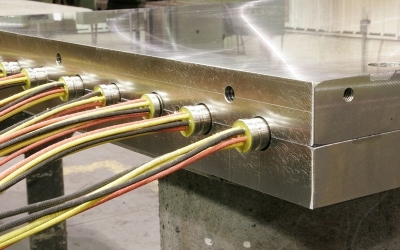
More than a press for stamping or shaping parts, custom heat platens are highly accurate thermal systems that apply controlled heat and pressure over a predetermined period of time. Delivering these capabilities are machined flat plates with an integrated temperature control system that uses electricity, steam, hot oil, or hot water to transfer thermal energy.
The platen is built for the existing press frame and control system, becoming central to a repeatable manufacturing cycle and accommodating materials with unique properties and heat tolerances. This process offers several advantages for OEMs that depend on composite molding:
- Consistency and Uniformity: Even and precise heat distribution significantly reduces issues that affect how a composite flows, cures, and solidifies. These attributes yield more uniform production between parts and cycles.
- More Advanced Manufacturing: Maintaining the balance between heat and pressure triggers a chemical reaction and contributes to a more efficient manufacturing process. The result enhances the composite’s properties and how it shapes to the mold.
- Part Integrity: Controlling the surface temperature helps to eliminate factors known to compromise part quality and performance, such as hot spots, warping, inconsistent curing, and internal stresses.
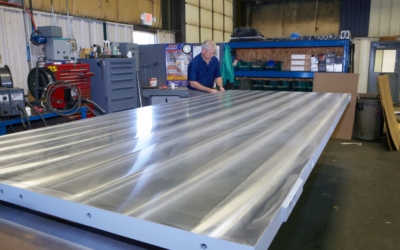
Manufactured from long-lasting steel, each platen is customized with features such as cut-outs, mold-mounting capabilities, and heating and cooling elements while meeting industry standards and project requirements. For aerospace and defense, this component is engineered for a process that produces parts for high-stress environments routinely exceeding 1,000˚F.
How Heated Platen Presses Support Part Manufacturing at Multiple Stages
Aerospace and defense manufacturers deploy custom heated platen presses for compression molding and to pre-impregnate and cure composite materials. This implementation streamlines cycles at multiple points:
- Creating lightweight impact- and heat-resistant components: Heated platen presses provide a controlled environment for manufacturing advanced composites. Through high pressure, temperature, and clamping forces, ultra-durable fibers cure and solidify into a resin with properties suited to takeoffs, landings, and other extreme applications. Learn more about heated platens for composite manufacturing.
- Precise, Uniform Heating: Intentional and controlled heating channels eliminate hot and cold spots, causing the material to harden evenly and perform as expected. All temperatures are calibrated to the application to prevent overheating, reinforce mechanical properties, and reduce waste.
- Reliable performance: Engineers design heated platens to remain flat, expand in a predictable manner, and deliver consistent results when exposed to high temperatures and thousands of tons of force.
- Process Integration: Platens are built to seamlessly attach to existing mounts and work unmodified with your facility’s heating system. Technologies like electrically heated and hydraulic platen presses take your setup further by shortening heat and recovery times, handling multiple materials and offering more control for pressure, temperature and cooling.
Altogether, these aspects not only power an OEM’s production processes but are also critical to controlling costs, time and part quality.
Venango Manufactures Innovative Custom Heated Platens for OEMs
A longtime leader in the platen manufacturing field, Venango Machine Company has grown into a trusted partner and supplier for OEMs in aerospace, defense, and other industries that leverage the possibilities of composites. Our state-of-the-art heat platen engineering capabilities continue to evolve with material advances and production demands, equipping your facility to produce new or retrofit existing parts to specific dimensions and high-performance applications.
Beyond processes, our MultiZone platens are establishing a new production standard for OEMs. Separate, region-specific controls accommodate differences in material composition and production specifications, delivering a highly variable platen system for increasingly complex and advanced applications.
Here’s how we support OEMs across several industries.
FAQs About Custom Heated Platens
What Manufacturing Standards Does the Aerospace Industry Follow for Composite Molding?
Composite parts for the aerospace industry must be manufactured in accordance with three industry standards:
- AS900D, based on ISO 9001:2015, specifies quality control guidelines for product safety, traceability, and risk management.
- AC7118 NADCAP (National Aerospace and Defense Contractors Accreditation Program) provides guidelines for auditing manufacturing processes.
- FAA Advisory Circulars (AC) establish a benchmark for product features and performance.
What Are Aerospace Composites?
Aerospace composites describe the following materials:
- Carbon fiber: A woven material coated with resin to offer exceptional strength for its weight. However, specialized curing between 500 and 1000°F is needed to achieve these properties. Learn more about our high-temperature platens for manufacturing carbon fiber.
- Fiberglass: This durable, conforming, and lightweight material is used to mitigate heat loss and can handle temperatures up to 1000°F.
- Sheet Molding Compound (SMC): Chopped glass and resin fibers are fused to manufacture durable large-scale parts that maintain their form.
- Bulk Molding Compound (BMC): Shorter glass fibers and resin are blended to manufacture small and medium-sized parts for vehicles and electrical systems.
- Titanium Matrix Composites: Reinforced fibers are added to titanium to create a stronger, more temperature-resistant alloy for engine, exhaust, and landing systems.
- Thermosets: When cured, this resin forms unbreakable chemical bonds that support heavy loads and resist melting, chemical exposure, and UV rays. In aerospace, they form wing skins, jet engine components, fuselage sections, and cabin parts.
- Aramid: Aramid fibers increase impact, heat, and abrasion resistance for aircraft panels and rotor blades.
What Are the Most Common Composite Aerospace Parts?
In aerospace manufacturing, composite parts are frequently created for the fuselage, wings, radomes, rudders, flaps, ailerons, and engine nacelles, as they improve aerodynamics, reduce operating costs, and withstand harsh, variable conditions.
How Are Composite Materials Used in the Defense Industry?
The defense industry has adopted composites for several field applications, as they offer exceptional strength for relatively low weight, improve fuel efficiency, resist corrosion, and offer less conspicuous construction. These applications include aircraft, unmanned aerial vehicles, submarines, ships, armored vehicles, and body armor.
What Manufacturing Standards Does the Defense Industry Follow for Composite Molding?
The Department of Defense has developed and implemented multiple standards for manufacturing parts from composite materials:
- MIL-HDBK-17 and MIL-STD-1944 specify material properties and processes for manufacturing, testing, and quality control.
- MIL-STD-1944 is a broad standard for developing and maintaining parts for military purposes.
- AS9100 Certification controls processes and product quality.
- DFAR Compliance has established supply chain standards for material sourcing.
The Department of Defense handbook covers these guides in more detail.
Request a Quote for Custom Heated Platen Presses
Each heated platen system is custom engineered by Venango Machine Company to achieve manufacturing objectives on a large, repeatable scale, where properties and composition underscore performance requirements. Our comprehensive capabilities deliver the conditions necessary for aerospace- and defense-grade composite molding, whether you design panels, gaskets, or other components.
Read more about our services before requesting a quote for your manufacturing process.